Market
Degausser Market Trends in India 2026
Indian degausser buying has changed. Per-cycle field verification, flash media and the destruction register now matter more than raw field strength. Here is what we are seeing across banking, ITAD, government and data centre enquiries.
Five years ago the Indian degausser conversation was almost entirely about price and field strength: how many Gauss, and how much. That has changed. Across the enquiries we handle — banks, ITADs, data centres, government departments, hospitals and universities — the decisive questions are now about evidence and about flash.
1. Per-cycle verification has overtaken field strength
The most common question we are asked is no longer "how strong is it?" It is "how do I prove it was strong enough when the cycle ran?"
The reason is easy to trace. Once a drive has been degaussed, nobody can independently prove it happened. So the only evidence available is what the machine recorded at the time. A cycle counter proves a cycle ran. A field reading proves the pulse was strong enough. In a bank inspection, a government audit, or a customer security questionnaire, only one of those answers the question.
That is why machines with built-in verification have moved from being a nice-to-have to being the deciding specification:
- T-4 — internal Gaussmeter reporting field strength on every cycle, removing the need for a separate instrument and a re-certification programme.
- T-1.5 — a pre-cycle software interlock that will not approve a cycle if capacitor voltage, switch state or any other parameter is out of tolerance. An under-strength pulse cannot be logged as a success.
- T-1.2 — a touchscreen reporting the field strength of every cycle.
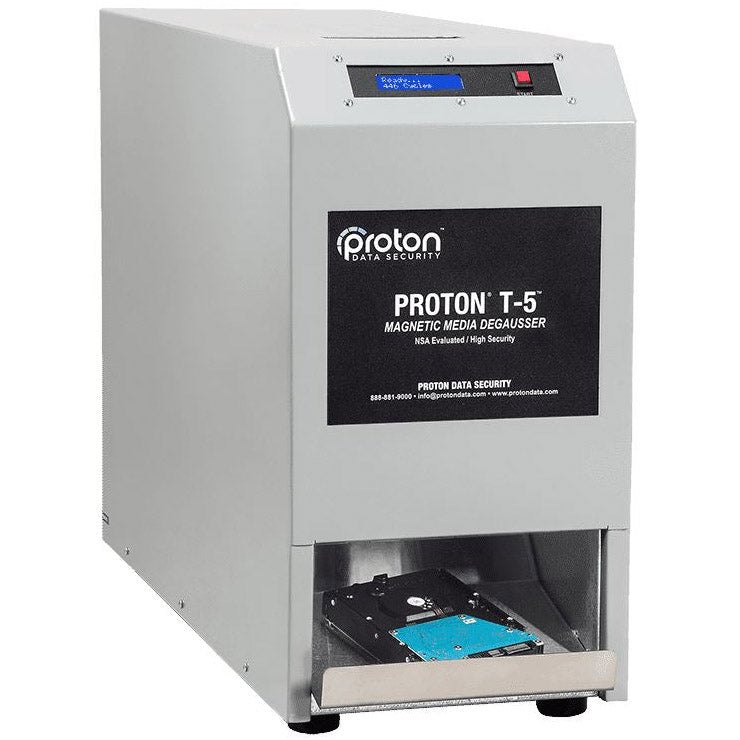
- T-5 — a digital cycle counter that becomes a running destruction log.
2. Flash is now the biggest gap in Indian media policies
A degausser cannot touch an SSD. Most Indian organisations bought their first degausser when hard drives were the medium, and a lot of policies still read "all media degaussed" without naming flash at all.
That assumption is now expensive. Enterprise storage in Indian data centres is substantially NVMe and M.2. Laptops are SSD-only. Branch and field devices are phones. And a degaussed SSD is a completely readable SSD.
What we see changing in 2026:
- Data centre policies are being rewritten to name media classes explicitly rather than saying "media".
- The PDS-88-class office shredder is appearing in specifications where a few years ago only a degausser was asked for.
- Device return and buy-back processes are being added to policies, because that is where unsanitised SSDs actually leave the building.
- Government and PSU specifications increasingly say "electronic media" rather than "hard drive", which forces the shredder into scope.
3. The destruction register has become the deliverable
For ITADs especially, the product is no longer the destruction — it is the document. A per-asset register with the machine, the verification value, the operator and the client custodian's signature is what closes a job and survives an audit.
Three developments worth noting:
- Bank clients are specifying their own register format as a contract annexure, rather than accepting the vendor's.
- Audit rights are being written in, with the client reserving the right to sample the register and inspect the equipment.
- Per-client exports are replacing single batch summaries, because a bank wants evidence for its own asset list, not an aggregate count.
4. E-waste rules are pulling disposal into the compliance conversation
The E-Waste (Management) Rules have made recycler authorisation and downstream documentation a standard question. Increasingly it is asked alongside the data question, not separately: who took the scrap, are they authorised, and can you show the chain?
This is a good development. The weakest part of most media destruction processes was always the final hop — sanitised media leaving the building in a container with no traceable destination. That is being closed.
5. Field service capability is a differentiator
Buyers ask more about service response than they used to. Two reasons: India is a large country with genuine last-mile problems, and buyers have been burned by grey imports with no India spares and an unanswerable warranty.
What gets asked, roughly in order: where are spares held, what is the response commitment in writing, who is the authorised service path, and will you issue a field verification certificate on the AMC visit. The last one is now the one that decides it.
6. Secure-room and battery operation are niche but growing
Requests for a degausser that runs without mains power are still a small share, but they are real — defence, bank strong-room-adjacent areas and secure facilities where a mains connection is undesirable. The T-4's 12 V battery operation option addresses exactly this, and it is the reason the T-4 remains the machine most often specified for secure-room work despite the T-5 being faster.
What we expect next
- More specifications naming a sanitisation standard (usually NIST 800-88) rather than describing an outcome.
- Flash destruction becoming a default line item rather than an add-on.
- More destruction-as-a-service, driven by organisations with low volume who still need a defensible register.
- Continued consolidation towards two or three machines per site — a degausser, a crusher and a shredder — with the register as the shared artefact.
- Tighter alignment between what a policy says and what the register can actually prove. That will favour machines with verification hardware, every year.
If your policy was written before any of this landed, it is worth re-reading against the media estate you actually have now. The compliance checklist is a fast way to find the gaps.
Frequently asked questions
Straight answers to the questions Indian buyers ask most often. Cannot find yours? Call us — we answer technical questions on the phone.